
KS205D-1 Doppler Ultrasound Phantom,KS205D-1 Doppler phantom
Mode:KS205D-1
Type:QA-Phantom
Contact: ken@hkmedqc.com
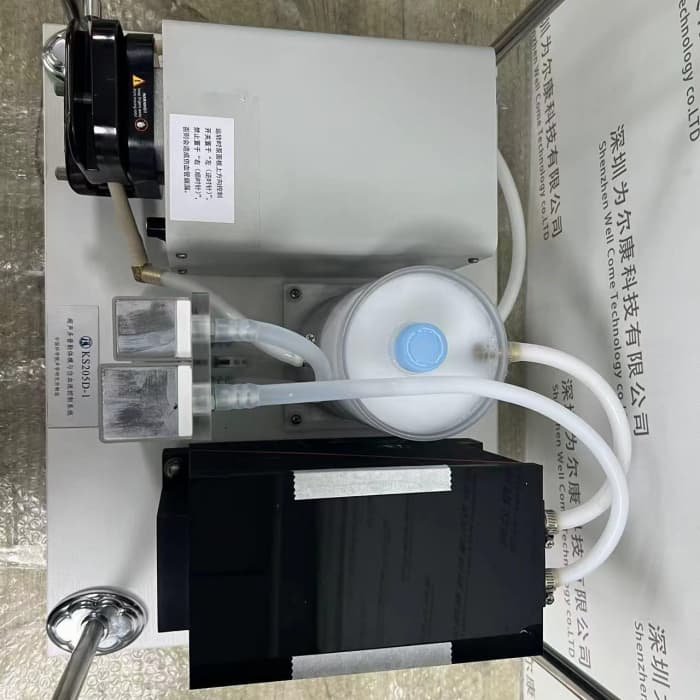
Ultrasonic Doppler instruments have stronger quantitative characteristics than grayscale imaging systems, and they are used to observe and diagnose dynamic targets.
Their performance testing equipment should have corresponding colors. B-ultrasound phantoms are "passive" devices, while string, band, disc, piston, small ball, and flow Doppler test objects are all active. However, among the six types of Doppler test objects listed, only the last one can be called a phantom, because it not only imitates human soft tissue and blood in terms of the acoustic properties of the material, but also, after being matched with a constant flow pump and a flowmeter, the ultrasonic simulated blood can circulate in a pipe buried in the simulated tissue material at a known angle, and its flow rate can be controlled and calibrated by non-acoustic methods. It can measure the most basic performance parameters of Doppler instruments, including direction recognition (direction identification) capability, sampling cursor position error, flow rate reading error, blood flow (maximum) detection depth, blood flow detection sensitivity, and other characteristics of the device under test, such as angle correction, spectrum aliasing, and color bleeding.Complies with the YY/T0458-2003 standard and the IEC61685-2001 standard.
Blood velocity or flow is the most important validity parameter that ultrasonic Doppler instruments can provide in clinical applications.
In KS205D-1 Doppler Ultrasound Phantom,KS205D-1 Doppler phantom, the flow is calibrated with the help of a calibrated online flowmeter; in order to calculate the flow rate,
the inner diameter of the simulated blood vessel is also strictly measured. The rotor flowmeter used in this system has two specifications: 6~60 (l/h) and 1~10 (l/h), and the two are used in series.
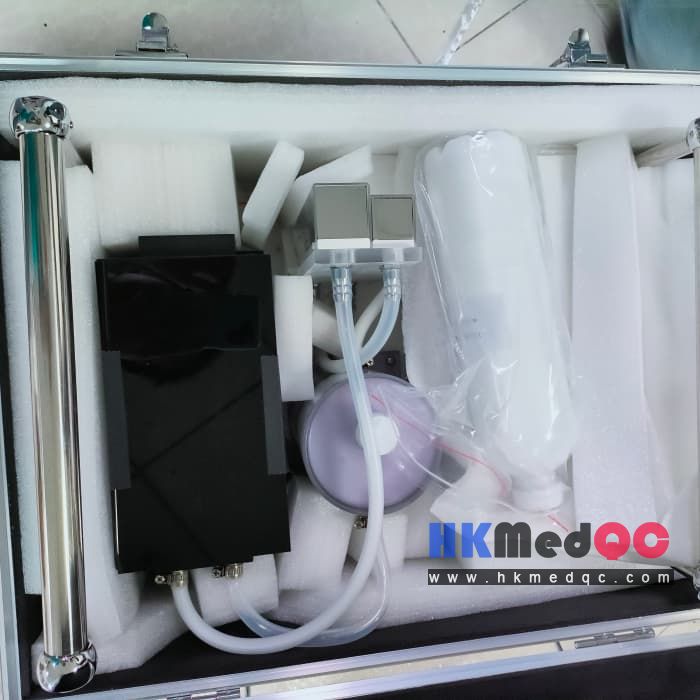
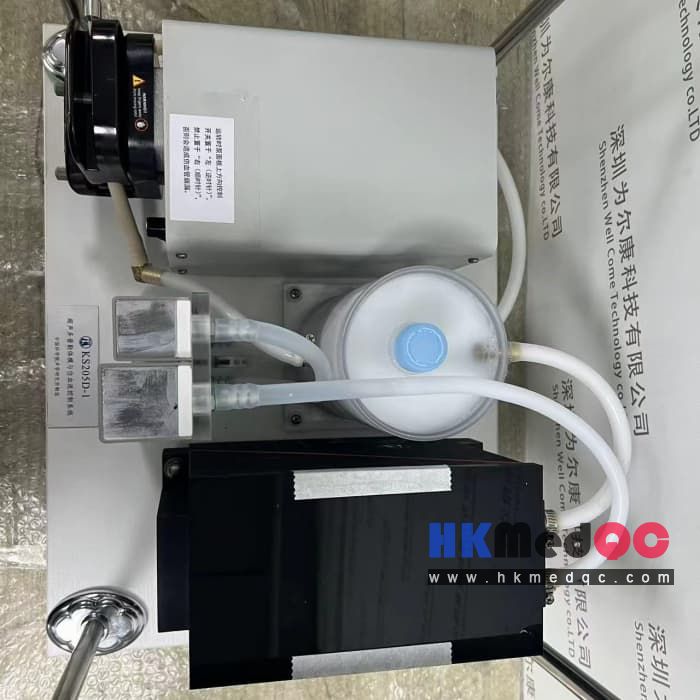
KS205D-1 Doppler phantom and simulated blood flow control system consists of five parts: Doppler phantom, simulated blood storage tank, constant flow pump, buffer and flow meter
Technical parameters of KS205D-1 Doppler phantom and simulated blood flow control system:
The technology specification of the Doppler phantom and the system are listed as following:
1. Doppler phantom internal dimensions(inside the housing):
200mm(length)×100mm(width)×170mm(depth).
1. Acoustic window size:
70μm(thickness)×200mm(length)× 100mm(width).
2. Ultrasound tissue-mimicking (TM) materials:
(1) TM material speed of sound: (1540±10)m/s (23±3℃).
(2) TM material slope of the attenuation coefficient: (0.50±0.05)dB/cm/MHz (23±3℃). ((if it is dedicated to detection
For Doppler instruments with high-end or low-end operating frequencies, TM materials with attenuation coefficients lower than or higher than this value can be selected, which must be specially customized.)
3. Ultrasound mimicking vessel:
(1) Density: 0.930(g/cm3).
(2) Material Sound Velocity: 1555 m/s.
(3) Material sound attenuation coefficient: It varies with the measurement frequency, see Table 1 for details.
(4) Diameter: The standard set is the same, 8mmand other sizes can be selected within the range of 4mm0.5 to 32mm2 times by a factor of 2, but must be specially ordered.
(5) Wall thickness: In the standard sleeve, the inner diameter is 8mm and the wall thickness is 1.6mm; the inner diameter is 4mm and the wall thickness is 0.8mm. If the inner diameter changes, the wall thickness changes accordingly, see Table 2 for details.
(6) Angle with the plane of the acoustic window: 30° in the standard case (oblique section), 45° and 60° are also available, but they must be specially ordered.
NOTE: Using the standard blood mimicking vessel, the inner diameter of the nominal 8mm and 4mm, respectively, blood flow velocity measurement can generally cover 2cm/s ~ 240cm/s. The vessel depth range is between 10mm ~ 130mm for the standard model KS205D-1. A customized type could be done if a zero-depth starting point or deeper depth of the blood vessel are required.
200mm(length)×100mm(width)×170mm(depth).
1. Acoustic window size:
70μm(thickness)×200mm(length)× 100mm(width).
2. Ultrasound tissue-mimicking (TM) materials:
(1) TM material speed of sound: (1540±10)m/s (23±3℃).
(2) TM material slope of the attenuation coefficient: (0.50±0.05)dB/cm/MHz (23±3℃). ((if it is dedicated to detection
For Doppler instruments with high-end or low-end operating frequencies, TM materials with attenuation coefficients lower than or higher than this value can be selected, which must be specially customized.)
3. Ultrasound mimicking vessel:
(1) Density: 0.930(g/cm3).
(2) Material Sound Velocity: 1555 m/s.
(3) Material sound attenuation coefficient: It varies with the measurement frequency, see Table 1 for details.
(4) Diameter: The standard set is the same, 8mmand other sizes can be selected within the range of 4mm0.5 to 32mm2 times by a factor of 2, but must be specially ordered.
(5) Wall thickness: In the standard sleeve, the inner diameter is 8mm and the wall thickness is 1.6mm; the inner diameter is 4mm and the wall thickness is 0.8mm. If the inner diameter changes, the wall thickness changes accordingly, see Table 2 for details.
(6) Angle with the plane of the acoustic window: 30° in the standard case (oblique section), 45° and 60° are also available, but they must be specially ordered.
NOTE: Using the standard blood mimicking vessel, the inner diameter of the nominal 8mm and 4mm, respectively, blood flow velocity measurement can generally cover 2cm/s ~ 240cm/s. The vessel depth range is between 10mm ~ 130mm for the standard model KS205D-1. A customized type could be done if a zero-depth starting point or deeper depth of the blood vessel are required.
Table 1 The frequency relationship of sound attenuation of vessel material
| f (MHz) | 2.0 | 3.5 | 4.0 | 5.0 | 7.5 | 8.0 |
| α(dB/cm) | 4.7 | 12 | 15 | 20 | 43 | 48 |
Table 2 Relationship between the inner diameter and wall thickness of the mimicking blood vessel
| Inner diameter (mm) | 4 | 8 |
| Wall thickness (mm) | 0.8 | 1.6 |
1. Ultrasound mimicking blood:
(1) Density: (1.05±0.04) (g/cm3).(2) Material Sound Velocity: (1570±30) m/s.
(3) Material sound attenuation coefficient <0.1dB/(cm·MHz).
(4) Backscatter: (1~10)×10-9 × f 4/(cm·MHz4 ·Sr).
(5) Viscosity: (4±0.4)×10-3 Pa·s.
2. Peristaltic pump,
(1) Number of revolutions: 0.2~300 RMP.(2) Number of pump heads: 1 or 2
(3) Silicone rubber hose: wall thickness 1.5mm, inner diameter 0.8, 1.6, 3.1, 4.8, 6.4, 7.9mm (optional).
(4) Flow range: 0.014~1140 ml/min.
(5) Control switch: Left/Stop/Right
(6) Speed control: adjustable potentiometer.
(7) Fluid flow way: through pipeline only
(8) Power supply: voltage 220±10% AC, frequency 50~60Hz
(9) Working environment: temperature 0~45 ℃, relative humidity < 80%
3. Flowmeter
Number: 2, used in seriesRange: 1~10L/h (i.e. 0.278ml/s~2.78ml/s)
6~60L/h (i.e. 1.67ml/s~16.7ml/s)
4. Mimicking blood reservoir tank
Capacity: 500ml;5. Buffer tank
Capacity: 500ml;KS205D-1 Doppler Ultrasound Phantom,KS205D-1 Doppler phantom Photos:
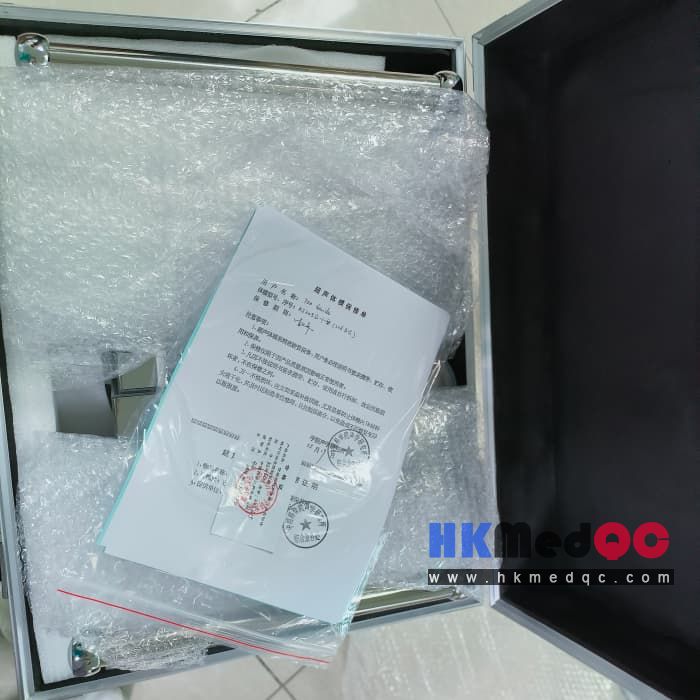
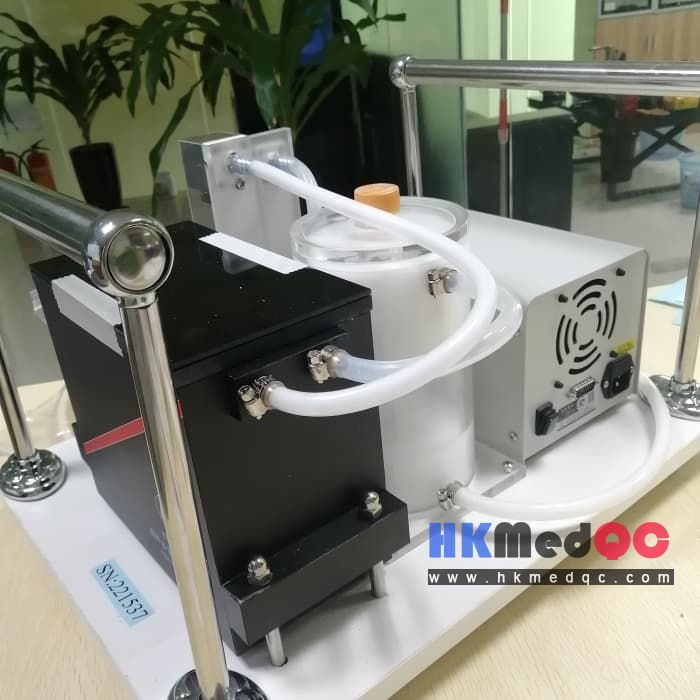
SAG: KS205D-1,KS205D-1 Doppler Ultrasound Phantom,KS205D-1 Doppler Phantom,Doppler Ultrasound Phantom,KS205D-1 phantom,IEC61685-2001