
WEK-SML ACR Magnetic Resonance Imaging Module
Mode:WEK-SML
Type:QA-Phantom
Contact: ken@hkmedqc.com
WRK-SML ACR Magnetic Resonance Imaging Module.pdf
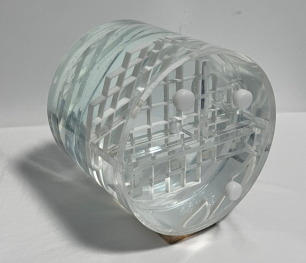
Basic Information
- Diameter: 203.2 mm
- Height: 173.4 mm
- Structure: Cylindrical cavity + internal test insert (grid / equally spaced holes)
- Orientation: NOSE / CHIN direction markers
- Applicable Field Strength: 1.5T / 3.0T and above (includes instructions for dielectric effect correction)
- Applicable Standard: ACR MRI Accreditation Standard
Phantom Specifications
Functions:
Suitable for the evaluation of imaging performance of small coils (limb coils, breast coils). Including: geometric accuracy, spatial resolution, slice thickness and positioning, low-contrast resolution, image uniformity, signal-to-noise ratio, artifact detection, slice offset, water-fat shift.
Technical specifications:
Diameter: 4.5 inches (approximately 11.43 centimeters) Cylinder length: 4.5 inches (approximately 11.43 centimeters).
Total length (including mounting bar): 5.375 inches (approximately 13.65 centimeters)
Functional inserts:
It shall include resolution inserts, slice thickness inserts, geometric distortion inserts, low-contrast inserts, and the like.
Other accessories:
All-plastic spirit level: Used to ensure the levelness of the equipment during installation and use. Phantom filling tools: shall include all utensils used in the process of removing air bubbles and replenishing the solution.


Key Performance
Geometric Accuracy
The assessment and evaluation of the extent to which an image accurately represents the true dimensions of the imaged object
High-Contrast Spatial Resolution
The test evaluates the scanner's ability to resolve small objects when the Contrast-to-Noise Ratio (CNR) is sufficiently high.
Slice Thickness Accuracy
The test evaluated the accuracy of slices in achieving a specified thickness. The prescribed slice thickness was compared with the measured slice thickness.
Slice Position Accuracy
The test evaluated the accuracy of specifying slices at specific locations using locator images as positional references.(The failure of the test indicates that the discrepancy between the actual position of the acquired slice and the specified position far exceeds the normal tolerance levels of a properly functioning scanner.)
Image Intensity Uniformity
The test measures the uniformity of image intensity within a large region located near the center of the imaging volume.
Failure of the uniformity test indicates that the variation in image intensity within the scanner/coil combination is significantly greater than that of a properly functioning system.
A lack of image intensity uniformity may suggest the following conditions:
(1) Intensity non-uniformity correction was not applied;
(2) A defect exists within the scanner;
(3) A defective head coil;
and/or (4) A problem exists within the RF subsystem.
Signal Ghosting Percentage
The test evaluated the degree of ghosting in ACR T1 images.
In this test, the signal level of ghosting artifacts is measured and reported as a percentage of the signal level in the true (primary) image.
These artifacts are most conspicuous in the background regions of the image—areas where no signal should be present—yet the ghosting also extends across the main body of the image, thereby altering the true image intensity.
(Failure of this test indicates the presence of ghosting artifacts at levels significantly higher than those typically observed in properly functioning scanners.)
Low-Contrast Object Detectability (LCD)
The test evaluates the extent to which low-contrast objects are recognizable within an image. To this end, the test pattern consists of four sections, each containing low-contrast objects that vary in both size and contrast.
This test failure means that the scanner produces images showing significantly fewer low-contrast objects than most normally functioning clinical scanners.
(Typically, a malfunction indicates a low signal-to-noise ratio. But sometimes, artifacts, such as ghosting, can also play a role.)