
Round Hole Card,WEK2043-2023 CT Resolution Phantom
Mode:WEK2043-2023
Type:QA-Phantom
Contact: ken@hkmedqc.com
Round Hole Card,WEK2043-2023 CT Resolution Phantom.PDF
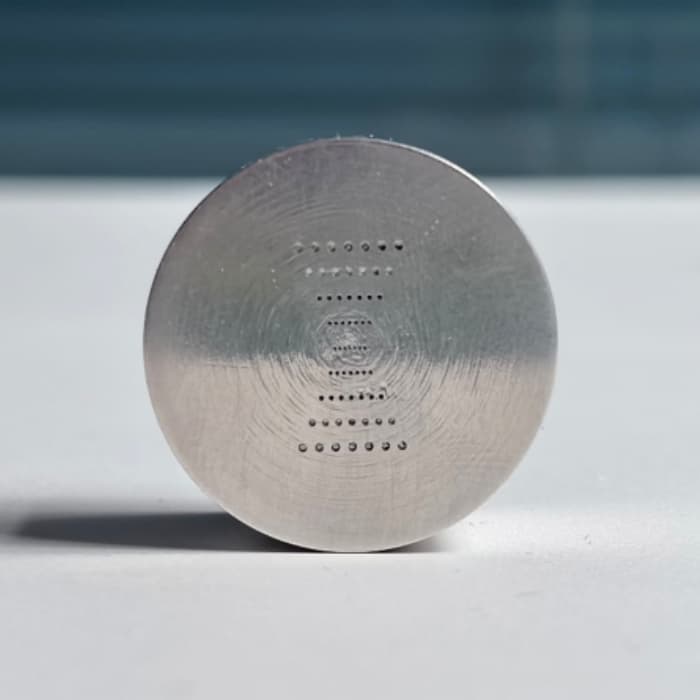
The circular hole-type test card method is used to test spatial resolution.
Overview
The spatial resolution is tested using circular hole-type test cards. The production of circular hole-type test cards can also be determined through negotiation between the supplier and the buyer.
The basic structure of circular hole-type test cards
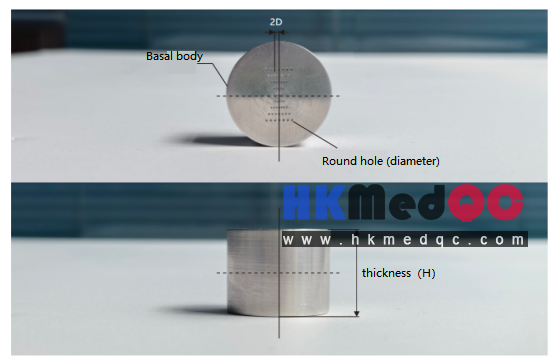
Circular hole-type test cards are made on a high-density cylindrical substrate [steel (such as Q235), aluminum (such as 3003), plastic (such as PMMA), etc.], with a series of circular holes of different diameters processed on it. The processing error should be less than 1%, and the holes are arranged in rows.Its basic structure is shown in Figure A.1.
The diameter of the circular hole-type test card can be designed according to specific circumstances. The thickness H is generally around 20 mm.
The diameter D of the circular hole card is 25 mm, and the thickness H is 20 mm; the hole diameters d of the circular hole card (in ascending order) are 0.2 mm, 0.3 mm, 0.4 mm, 0.5 mm, and 0.6 mm.
Calculation of spatial resolution
According to formula (1), calculate the spatial resolution R of the system:
R =(1/2)×1/D m in (1)
In the formula:
R —— Spatial resolution, Lp/mm;
Dm in —— The smallest aperture that can be distinguished on the CT image (distinguished at 10% modulation), mm.
Note: The minimum diameter of the round hole should be: 0.132mm.
Overview
The spatial resolution is tested using circular hole-type test cards. The production of circular hole-type test cards can also be determined through negotiation between the supplier and the buyer.
The basic structure of circular hole-type test cards
Circular hole-type test cards are made on a high-density cylindrical substrate [steel (such as Q235), aluminum (such as 3003), plastic (such as PMMA), etc.], with a series of circular holes of different diameters processed on it. The processing error should be less than 1%, and the holes are arranged in rows.Its basic structure is shown in Figure A.1.
The diameter of the circular hole-type test card can be designed according to specific circumstances. The thickness H is generally around 20 mm.
The diameter D of the circular hole card is 25 mm, and the thickness H is 20 mm; the hole diameters d of the circular hole card (in ascending order) are 0.2 mm, 0.3 mm, 0.4 mm, 0.5 mm, and 0.6 mm.
Calculation of spatial resolution
According to formula (1), calculate the spatial resolution R of the system:
R =(1/2)×1/D m in (1)
In the formula:
R —— Spatial resolution, Lp/mm;
Dm in —— The smallest aperture that can be distinguished on the CT image (distinguished at 10% modulation), mm.
| R | D mm (Unit:mm) | Round hole tolerance:±1% |
| 1.6 | 0.313 | 0.003 |
| 1.8 | 0.278 | 0.003 |
| 2.0 | 0.250 | 0.003 |
| 2.2 | 0.227 | 0.002 |
| 2.6 | 0.192 | 0.002 |
| 3.0 | 0.167 | 0.002 |
| 3.4 | 0.147 | 0.001 |
| 3.8 | 0.132 | 0.001 |
SAG: Round Hole Calibration Card,Industrial CT Phantom,NDT Defect Detectability,Multi-Size Hole Phantom,Aluminum Calibration Disc,X-ray Resolution Test,Dimensional Accuracy Calibration,Round Hole Phantom