
YM-1 Ultrasound Power Measurement Mask,YM-1 Phantom
Mode:YM-1
Type:QA-Phantom
Contact: ken@hkmedqc.com
YM-1 Ultrasound Power Measurement Mask,YM-1 Phantom.PDF
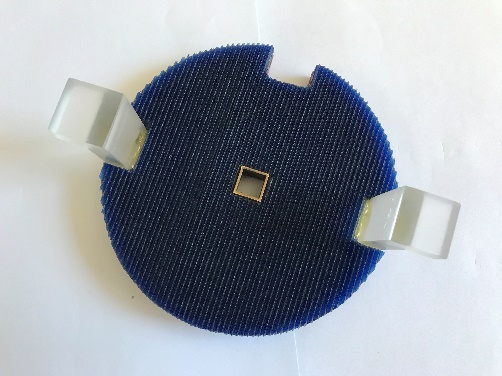
The mask used for measuring the acoustic power of the YM-1 ultrasound diagnostic equipment is developed by the Institute of Acoustics of the Chinese Academy of Sciences. It is specifically designed for testing the acoustic output power of convex array and phased array probes, and fully complies with the requirements of IEC 60601-2-37 and GB 9706.9-2008 standards.
3. Reflection coefficient of window wall material: >90%
It uses high-damping sound-absorbing materials to block the scanning sound beam and suppress reflection interference. Only the central parallel acoustic beam of the probe passes through the φ10mm aperture, accurately measuring "bounded acoustic power". It is compatible with the radiation force balance measurement system and is widely used in the quality inspection of ultrasound equipment, calibration of measurement institutions, manufacturer research and development, and factory inspection. It is a standard supporting component for the transmission of medical ultrasound power values.
(1) Placing a component known as a "mask" between the probe and the target to intercept the majority of the acoustic beam—particularly when the probe is in scanning mode—without generating reflections; this allows only the quasi-parallel central portion of the beam to pass through a 1 cm wide aperture and impinge upon the target;
(2) Modifying the target of the radiation force balance to a width of 1 cm, orienting its longitudinal axis perpendicularly to the longitudinal axis of the probe's radiating surface, and ensuring that no reflected waves impinge upon the target;
(3) For specific probe types—such as phased arrays—employing electronic control techniques to restrict ultrasonic emission solely to the central 1 cm section of the radiating surface.
Of these three methods, the second requires physical modification of the power meter, while the third necessitates the development of specialized acoustic beam scanning software; both present significant practical difficulties for both the manufacturers and the end-users of power meters. Consequently, the first method—owing to its superior operational feasibility—has emerged as the preferred approach within the industry. To facilitate the implementation of the GB 9706.9–2008 standard, we have specifically developed and manufactured the Model YM-1 1 cm Aperture Mask, a device designed to comply fully with the requirements stipulated in this standard.
YM-1 Ultrasound Power Measurement Mask Photo:
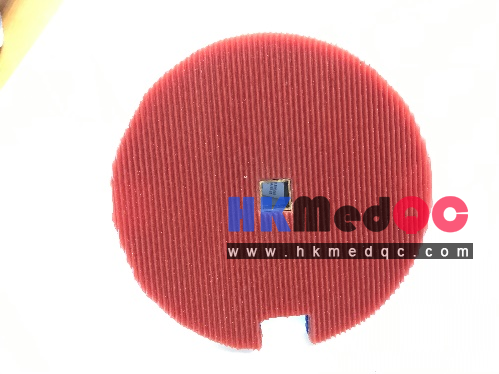
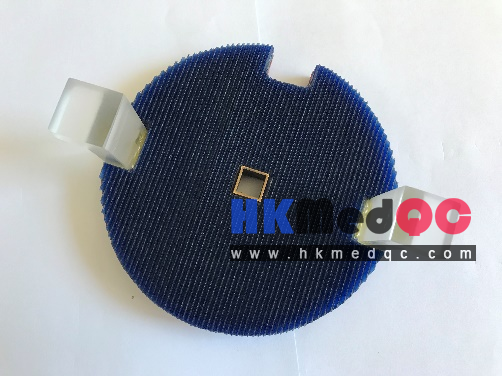
The technical characteristics of the mask 1. Absorption layer for reducing reverberation: >30dB (f > 2.5 MHz)
2. Overall insertion loss of three layers: >50dB (f > 2.5 MHz)To address this, IEC 60601-2-37 and the equivalent national standard GB9706.9—2008 have proposed three methods to measure the "bounded sound power" on the radiation surface of a 1 cm long probe. These include:
(1) Place a component called a "mask" between the probe and the target. This component will cut off most of the sound beam in the scanning state and prevent reflection, leaving only the parallel central part of the probe projecting through a 1 cm wide opening onto the target body;
(2) Change the target of the radiation force balance to 1 cm wide, ensuring that its length is orthogonal to the length of the probe's radiation surface, and ensuring that no reflected waves project onto the target;
(3) For some probes such as phased arrays, adopt electronic technology to only allow the central 1 cm length of the radiation surface to emit ultrasonic waves.
Among these methods, the second one requires modifying the power meter, and the third one requires specially designing a sound beam scanning program. Both are difficult for the manufacturing and users of the power meter. Only the first one has the strongest operability, so it has become the industry's preferred choice. To support the implementation of GB9706.9—2008, we specially developed and produced the YM-1 type 1 cm aperture mask that fully complies with the requirements of this standard.
(1) Placing a component known as a "mask" between the probe and the target to intercept the majority of the acoustic beam—particularly when the probe is in scanning mode—without generating reflections; this allows only the quasi-parallel central portion of the beam to pass through a 1 cm wide aperture and impinge upon the target;
(2) Modifying the target of the radiation force balance to a width of 1 cm, orienting its longitudinal axis perpendicularly to the longitudinal axis of the probe's radiating surface, and ensuring that no reflected waves impinge upon the target;
(3) For specific probe types—such as phased arrays—employing electronic control techniques to restrict ultrasonic emission solely to the central 1 cm section of the radiating surface.
Of these three methods, the second requires physical modification of the power meter, while the third necessitates the development of specialized acoustic beam scanning software; both present significant practical difficulties for both the manufacturers and the end-users of power meters. Consequently, the first method—owing to its superior operational feasibility—has emerged as the preferred approach within the industry. To facilitate the implementation of the GB 9706.9–2008 standard, we have specifically developed and manufactured the Model YM-1 1 cm Aperture Mask, a device designed to comply fully with the requirements stipulated in this standard.
YM-1 Ultrasound Power Measurement Mask Photo:
The technical characteristics of the mask 1. Absorption layer for reducing reverberation: >30dB (f > 2.5 MHz)
3. Reflection coefficient of window wall material: >90%
SAG: YM-1 Ultrasound Mask,Power Measurement,Ultrasonic Calibration,Beam Limiting Mask,Diagnostic Ultrasound,IEC60601-2-37,YY/T 1084-2015,Acoustic Measurement,Ultrasound Probe Test,Medical Ultrasound Phantom